Grants and Collaborations

TRR 257: Particle Physics Phenomenology after the Higgs Discovery
DFG Collaborative Research Centre
The CRC/Transregio, funded by the German Research Foundation (DFG) since 2019, strives to advance the understanding of Nature at its most fundamental level through the study of elementary particles and their interactions.
Model-Based AI: Physical Models and Deep Learning for Imaging and Cancer Treatment
Carl-Zeiss-Stiftung
The CZS Initiative for Model-Based AI (MBAI), funded by the Carl Zeiss Foundation (CZS) since 2023, aims at combining modern ML methods with mathematical models to develop processes that can be applied in the highly relevant field of cancer research.
IMPRS-PTFS: International Max Planck Research School for Precision Tests of Fundamental Symmetries
Max-Planck-Gesellschaft
The IMPRS-PTFS, established in 2019 by the Max Planck Institute for Nuclear Physics (MPIK) and Heidelberg University, provides interdisciplinary doctoral training to explore the most fundamental laws of nature through both theoretical and experimental approaches in particle, nuclear, atomic, and astroparticle physics.
AIPHY: Challenging AI with Challenges from Physics
Marie Curie Doctoral Network
AIPHY, a doctoral network funded by the European Commission in the context of the Marie Skłodowska-Curie Actions (MSCA), aims at solvin fundamental problems in physics by AI and vice versa.

KISS: Artificial Intelligence for the Fast Simulation of Scientific Data
Federal Ministry of Research, Technology and Space
The joint project KISS (Künstliche Intelligenz zur schnellen Simulation von wissenschaftlichen Daten), funded by the Federal Ministry of Research, Technology and Space (BMFTR), conducts interdisciplinary research to simplify, accelerate, and improve simulations through scientific AI. We use deep learning to accelerate classical simulation approaches or to create fast surrogate models.
MCnet: Monte Carlo Event Generators for the LHC Era and Beyond
International Community
MCnet is an international community organisation (originally an EU-funded Marie Curie Initial Training Network) of high-energy physics theorists, experimentalists, and software developers behind the leading techniques and tools for simulating fully exclusive particle-collision events.
Completed Projects

GRK 1940: Particle Physics beyond the Standard Model
DFG Research Training Group
The Research Training Group, funded by the German Research Foundation (DFG) from 2014 to 2023, trained doctoral students in both theoretical and experimental particle physics, focusing on key open questions such as the Higgs sector, dark matter, flavor anomalies, and matter-antimatter asymmetry.
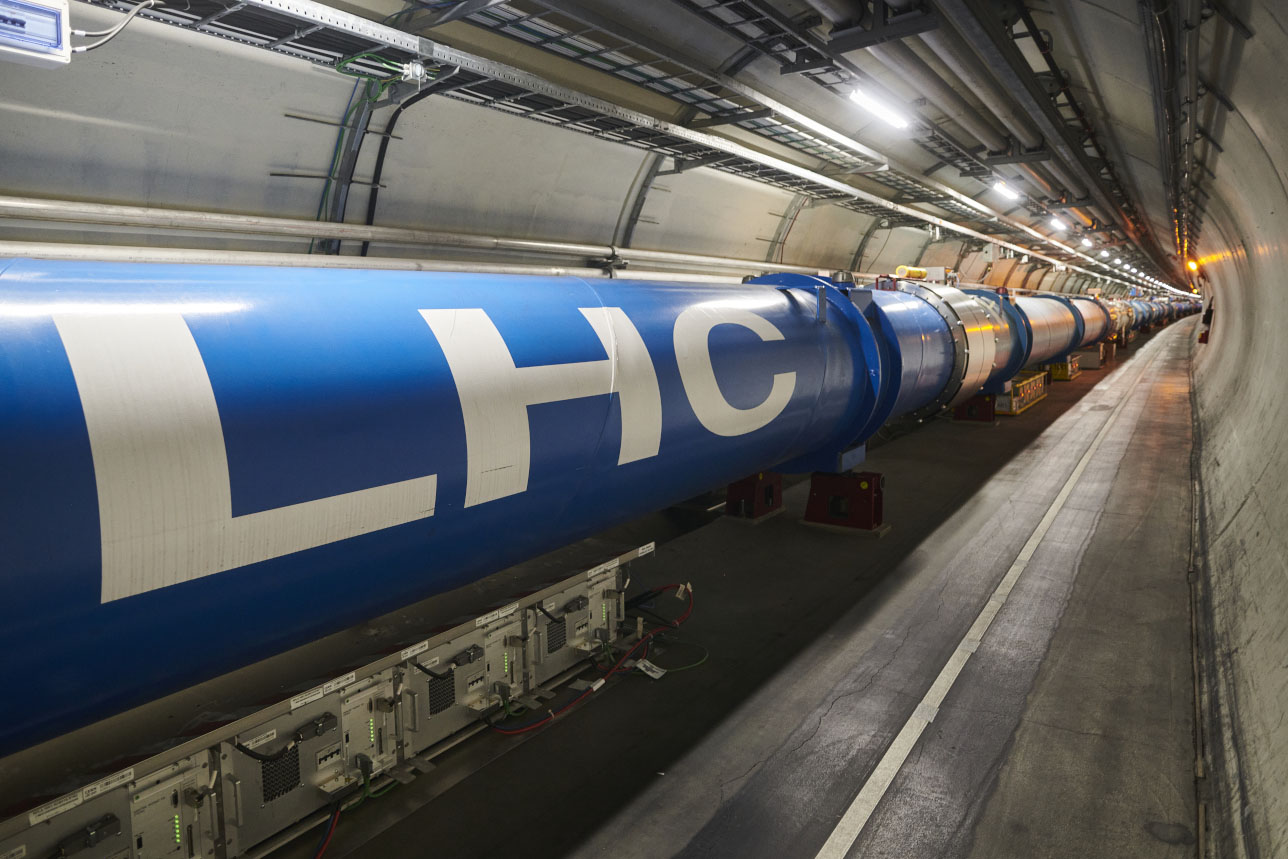
FOR 2239: New Physics at the Large Hadron Collider
DFG Research Unit
The DFG Research Unit, funded by the German Research Foundation (DFG) from 2015 to 2020, focused on theoretical calculations and analyses of new physics scenarios addressing the hierarchy problem and the nature of dark matter, providing precision predictions and global interpretations to guide and exploit LHC searches beyond the Standard Model.