Phenomenology of
nonperturbative approaches to QCD, current correlators
Nonperturbative analytics of pure gauge theories
Mathematics of Yang-Mills thermodynamics and its deformations, links to analytic number theory
Cosmology:
(i) CMB power spectra and the cosmological model, CMB large-angle anomalies
(ii) Dark Universe and structure formation
(iii) Galaxies and condensates of ultralight axions
(iv) Reionisation, missing baryons, and primordial nucleosynthesis
(v) Lepton asymmetry
(vi) Cosmic Inflation
Fundamentals of Electroweak Symmetry Breaking
Pure Yang-Mills theory and the foundations of Quantum Mechanics
Carlos Falquez: Experimental investigation of BB anomaly; resummation.
Diploma thesis
Niko Krasowski: Exclusion of photon-photon scattering in deconfining Yang-Mills plasma.
Paper on Master thesis
Ingolf Bischer: Resummation of 2-PI bubble diagrams in deconfining SU(2) Yang-Mills plasma.
Paper on Master thesis
Fabian Trost: Non-local and non-linear aspects of Fresnel diffractograms.
Master thesis
Janning Meinert: Condensates of ultralight axions and the Dark Universe. Propagation of ultrahigh-energy cosmic rays. Blackbody spectral anomaly. CMB. Emergent leptons.
Paper on Master thesis
SU(2) or SU(3) Yang-Mills thermodynamics, nonperturbatively
Each of these two theories is defined in terms of interacting, massless
gauge fields subject to an infinite spacetime resolution. In a (Euclidean) thermodynamical formulation and at sufficiently high temperatures,
apart from the propagating fields, which are solutions to the field equations in the
limit of zero coupling only, nonpropagating solutions (calorons) exist at
any value of the coupling strength. These calorons
can be interpreted as quantum
fluctuations, endowing propagating modes with a quantum dispersion. In spite of their selfduality, which entails zero pressure and energy density (BPS saturation), calorons carry a potency of originating mostly short-lived, massive, and charged matter
upon deformation through inelastic scattering with propagating modes. More specifically, in a
given caloron, a nontrivial holonomy is generated which implies a manifest pair of a magnetic monopole and its
antimonopole. BPS saturation of the caloron configuration
is lifted together with a departure from trivial holonomy. Notice that also BPS saturated
configurations of topological charge modulus |Q|=1, which are of nontrivial
holonomy, were constructed. However, the static
holonomy parameter inherent to these solutions of the Yang-Mills equations
annihilates their potential contribution to
the partition function in the infinite-volume limit. In a caloron, deformed away
from trivial holonomy by inelastic scattering with a propagating mode, the by far typical situation is
that a monopole attracts its antimonopole and vice versa thus causing the
system to degenerate back into a pointlike monopole and an antimonopole whose charge is smeared
across the entire 3-space. Once this situation is re-instated the life-cycle of the
monopole-antimonopole pair can start over again.
Very rarely though, there is repulsion between
these magnetically charged constituents of a strongly deformed caloron. This facilitates a much longer
life of the monopole and its antimonopole in isolation. Thermodynamically, the overwhelming situation
of attraction leads to a negative ground-state pressure. By frequent
interactions with caloron centers a part of the spectrum of propagating
gauge fields acquires mass (adjoint Higgs mechanism). As a consequence, the computation of
thermodynamical quantities such as the pressure or the energy density
is enabled in an extremely efficient way: The so called
loop-expansion converges very rapidly. It is important to point
out that as of yet only the case of unadulterated thermodynamics is under theoretical control.
Local distortions by static or time dependent
sources can be accounted for in terms of adiabatic approximations due to the
strongly correlating nature of the thermal ground state.
Using effective-theory methods, we can show
that, although isolated and screened magnetic monopoles and antimonopoles do
exist in the deconfining plasma, their net flux at distances comparable to the magnetic
screening length is too small to generate an area law for the spatial Wilson
loop at large spatial contour size. This is in contrast to the results of lattice gauge
theory. We strongly suspect the reason for this discrepancy to be rooted in the
use of the Wilson action at finite lattice spacing a.
Both theories, SU(2) and SU(3) Yang-Mills, undergo
two transitions to phases with reduced gauge symmetry if temperature
is decreased. There is a very narrow, intermediate phase where all propagating gauge
fields are massive. In that phase the overall pressure is
negative and dominated by the physics of contracting, magnetic
vortex loops, embedded into a condensate of magnetic monopole-antimonopole pairs.
The transition between to the low-temperature phase is characterised by a stark deperture from thermal equilibrium and
that fact that excitations change their statistical
properties: (Center-)vortex loops with a single selfintersection and no slefintersection at all
are now (quasi-)stable, vortex loops with higher intersection numbers are instable
and occur with large abundancies.
If there are selfintersections
within a given vortex loop then the associated state is a massive, charged or neutral
spin-1/2 fermion, if there is no selfintersection
then the state is associated with a nearly massless spin-1/2 Majorana fermion.
Remarkably, the ground-state pressure is precisely zero
in the low-temperature phase (cosmological constant problem). This statement is demonstrated by integrating
out all fluctuations enabled by the (slightly unconventional) Borel summability
of the asymptotic series representing the pressure. As a by-product the growing violation of thermal
equilibrium by turbulences is shown with increasing temperature.
We believe that this result is of relevance when addressing the
instability problems encountered in terrestial nuclear fusion experiments
with magnetic plasma confinement. Together with Sakharov's three
conditions for the generation of charge-asymmetry and condensed Planck-scale axions this gross violation of thermal
equilibrium by the fluctuations of very abundant but
instable objects may be responsible for lepton-number violation in the very early Universe
Radiation history of the Universe and massive photon in the future
Most of the photons in our world are part of the so-called cosmic
microwave background radiation (CMB) which, in an ever cooling Universe,
got released by the formation of neutral hydrogen atoms at
about 400.000 years after the Big Bang (recombination).
From that epoch onwards the conventional
view is that CMB photons, which became less and less energetic
by their redshift due to the Universe's expansion, did not interact with anything except for the free electronic charges
that are provided by reionized gases induced by radiation stemming from stars
(reionization of the Universe).
An entirely new perspective on the issue of reionization
emerges if one allows for an embedding of the U(1) gauge group, associated
with the photon, into a larger gauge symmetry SU(2).
Namely, a nonperturbative analysis of SU(2)
thermodynamics reveals that there is only one point in temperature T(c,E) in the
phase diagram of this theory where, in accord with our
daily experience, the photon is precisely
massless and un(anti)screened. Thus one is lead to
identify the present temperature of the CMB of about 2.7 Kelvin
with T(c,E). With the Universe's temperature being slightly higher than T(c,E), however, the photon
experienced tiny interactions with charged and massive vector
particles whose existence is an immediate consequence of the (dynamically broken)
SU(2) gauge symmetry. The effect of these interactions on
the fluctuations of the CMB temperature and its electric-field
polarization peaks at a redshift of about z=1 and dies
off rapidly for larger redshifts (or temperatures). Observationally (WMAP 5
years), the dipole and monopole subtracted angular two-point
correlation of temperature is consistent with zero for angles larger than 60
degrees, and the spatial orientations of low-lying multipoles
seem to be statistically correlated. There is potential for these large-angle 'anomalies' in
the CMB to be resolved by the effects of SU(2) adulterated propagation of
thermalized photons at temperatures of about twice the present CMB
temperature.
Another interesting consequence of SU(2) gauge dynamics
determining the physics of the CMB is the prediction
that the CMB photon necessarily would have to become
massive by an event taking place suddenly in
less than 2.2 billion years because the Universe's ground
state would then transform into a superconductor.
Observational evidence for the CMB being on the verge of a phase transition
The data on CMB line temperatures at very low frequencies (Arcade2,
radio-frequency surveys, one of
Arcade2's papers) point towards a huge excess in comparison with the CMB
baseline temperature T=2.725 K extracted at higher frequencies by FIRAS
(COBE). This excess can be explained by presuming that the present CMB baseline
temperature is just slightly below the critical temperature of the
deconfining-preconfining transition thus generating a Meissner mass for
low-frequency CMB photons. If the frequency falls below this mass then the
associated mode can no longer propagate as a wave (evanescence). As a
consequence, its contribution to the frequency spectrum of intensity no longer
follows the Planck curve. The intensity of calibrator modes, however,
is strictly Planck (or Rayleigh-Jeans) distributed. Thus, by nulling the former
with the latter one actually compares `apples' with `pears' giving rise to
the before-mentioned excess of line temperature. Extracting the
photon mass from the data, one observes saturation of its value at the
lowest frequencies. This and the fact that the asymptotic spectral index for line
temperature T as a function of frequency, which theoretically is -2, starting
from about -2.62 moves in
the right direction when invoking lower and lower frequencies in the according
fit to the data, indicates that the CMB is on the verge of a phase transition towards a superconducting ground
state. Since a U(1) gauge theory for photon propagation predicts a trivial
phase diagram and since there is only a single species of photons
the only viable candidate gauge theory is based on the group SU(2).
Gap in the blackbody spectrum at low temperatures and low frequencies
A consequence of an SU(2) gauge symmetry being responsible for the existence of
propagating photons is the prediction that the blackbody spectrum exhibits a sizable
gap at low momenta and temperatures. Interestingly, this spectral gap decays
with the same power one half of temperature as the effective adjoint scalar
field (average over noninteracting trivial-holonomy caloron centers) does.
Physically, the gap emerges because photons are screened
by the charged and massive vector modes of the SU(2) theory. The effect is entirely
negligible for temperatures, say, larger than 50 Kelvin, and it is absent at the
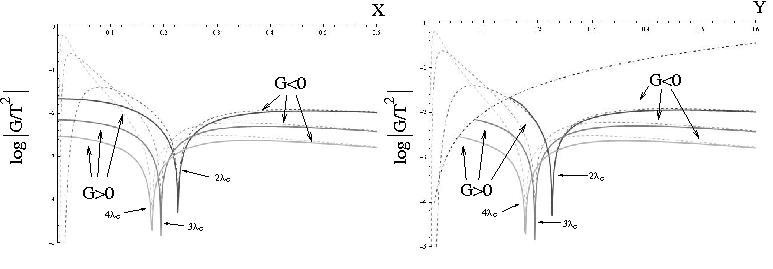
present temperature of the CMB: T(c,E)=2.73 Kelvin. The figure shows the screening function
|G| as a function of photon momentum (left) and photon frequency (right) all scaled dimensionless with appropriate
powers of temperature (logarithmic plot).
The various solid lines correspond to the exact SU(2) results for T=5.45 (dark grey), 8.2 (grey), 10.9
(light grey) Kelvin, the respective dashed lines are SU(2) results
obtained within the approximation that the photon's momentum is on its U(1)
mass shell (p squared equals zero). To the right of
the deep dip G is negative (antiscreening) while it is positive to the left of
the dip (screening). There is a rapid rise of G to the left of the dip indicating
that the photon's (screening) mass increases strongly with a decreasing
momentum.
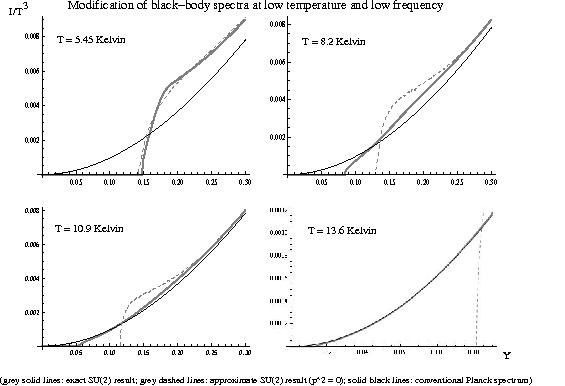
The black dashed line in the right panel indicates the endpoint in frequency for photon
propagation. For low-temperature and low-frequency modifications of black-body
spectral energy density see the next figure. Dashed lines indicate the SU(2) results in
the approximation that the photon's momentum is on its U(1)
mass shell (p squared equals zero), the grey solid lines are the exact SU(2)
result, and the solid black lines refer to the conventional Planck
spectrum of energy density. All quantities are dimensionless in natural units (c=hbar=k=1). In
particular, Y=omega/T is the dimensionless frequency.
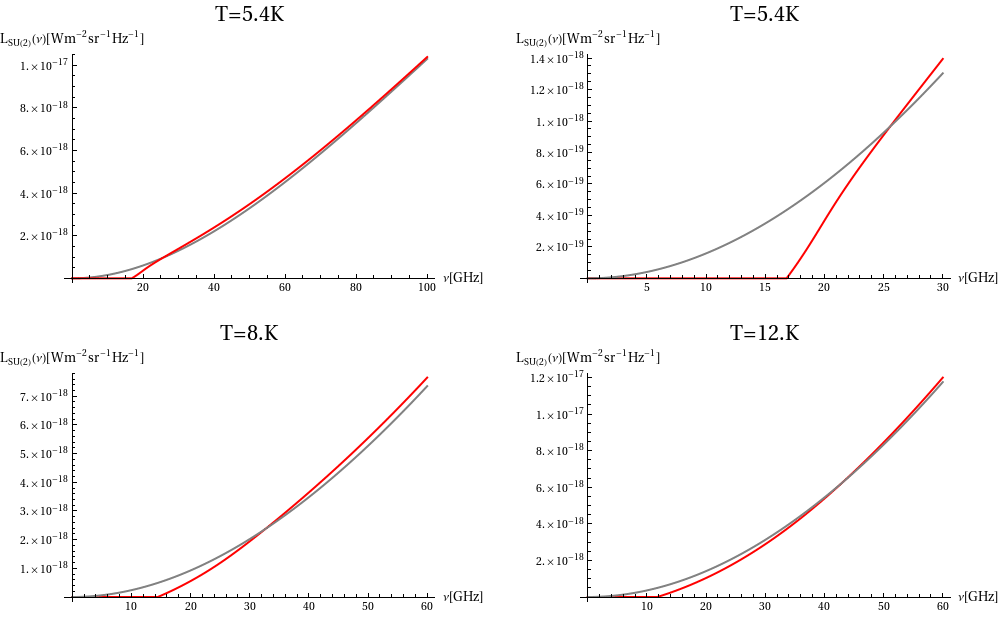
Below, we also show the spectral radiance in SI units for the SU(2) black body
(spectral radiance and not
spectral energy density is the quantity measured radiometrically)
at temperatures 5.4, 8 and 12 Kelvin. Red curves are the SU(2) modified spectra
and grey curves the convential Planck spectra.
There is a certain amount of astrophysical evidence that an SU(2) gauge theory
could describe photon propagation: The observation
of large, cold, and dilute clouds of atomic hydrogen inbetween spiral
arms of our galaxy. (There is no standard explanation why the hydrogen
atoms did not form molecules over a period of about 50 million years,
see L. B. G. Knee and C. M. Brunt, Nature 412, 308-310 (2001)). An SU(2)
gauge theory, however, explains the absence of the photons required for the
mediation of the dipole force between hydrogen atoms by a large screening.
The absence of these photons possibly also explains why there is a suppression
of large angles in the CMB temperature-temperature correlation function:
The correlation of temperature fluctuations, that is present within the standard U(1) description of
photon propagation, is strongly suppressed at low redshifts because long-wavelength
photons are switched off by screening. Moreover,
appealing to the violation of the conventional temperature - scale factor relation at
low redshift as introduced by the (nonconformal) SU(2) equation of state,
it appears that the discrepancy of redshift for
instantaneous reionisation, as extracted from an analysis of the TT
angular CMB spectrum (z~11, Planck collaboration) and
by onset of the Gunn-Peterson trough at z~6.28 (R. Becker et al., 2001), is resolved.
Reduced dark matter at high redshifts and the value of H0
Based on a modified temperature-redshift relation for the CMB, due
to the assumption that it is an SU(2) rather than a U(1) photon gas, one concludes by a simple
argument that during this epoch the dark-matter density parameters is reduced compared to the one of
LambdaCDM cosmology. For such a cosmological model to match LambdaCDM at low redshift
an epoch is required where dark matter is being created from dark energy. Fitting the cosmological
parameters of the modified model to the CMB power spectra observed by the PLANCK collaboration, the discrepancies
between reionisation redshifts, baryon densites, and the value of H0 are resolved in favour of cosmologically
local observation.
Large-angle anomalies of the CMB, confirmed by PLANCK
The rapid build-up of a cosmologically local, spherically symmetric temperature
profile at redshift around one (or a former CMB temperature of about 5.5 Kelvin),
sourced by the black-body anomaly arising from thermal, generalised photon dynamics due to the above-mentioned SU(2) Yang-Mills theory of
scale 0.0001 eV, would explain the soundly confirmed suppression of the TT
correlation function at angles > 60 degrees
(PLANCK-CMB).
For a 2D analogue, imagine a trampoline whose wobbling surface represents
primordial temperature fluctuations of equal strength on all length scales
within the visible Universe (horizon defined by the trampoline frame). Imagine further that the
center of the trampoline's surface is locally depressed by pull from a
rope attached to it from below. The amplitude of this depression supposedly is a
hundred times larger than the typical amplitude of a primordial wobble.
This creates a 2D spherically symmetric profile whose gradient defines a preferred direction for an
`observer' located at a given point of its slope. While primordial wobbles of large scales (order z=1) are smoothed
by this process small-scale fluctuations are much less affected. In the CMB the gradient to the black-body anomaly
induced 3D spherically symmetric temperature profile gives rise to a dynamic contribution to the
CMB dipole, plausibly accounting for the discrepancy between the relativistic Doppler-shift inferred and gravitationally
surveyed motion of the Local Group of galaxies, and it predicts a Cold Spot.
Solitonic fermions and the dark Universe
The doublets of single and one-fold selfintersecting center-vortex loops, as
they emerge as stable solitons in the confining phase of an SU(2) Yang-Mills theory, may
represent the lepton families of the Standard Model of Particle Physics (SMPP). If
true then this would mean that the fundamental gauge-symmetry structure of leptons
and their weak (very weak and very, very weak) interactions is a triple product
of SU(2) with Yang-Mills scales corresponding to the masses of charged leptons. The
apparent structurelessness of the latter down to small distances, as inferred from
high-energy collision experiments, would then be a consequence of the
excitability of a tower of instable vortex loops with a larger number of
selfintersections than unity and the thermal nature of the blob of selfintersection which
contains a frequently perturbed monopole providing the charge of the soliton.
The interplay a gravitational chiral symmetry breaking at the Planck scale
with these SU(2) Yang-Mills theories, based on the axial anomaly, produces ultralight axions whose condensates would represent a unification of
astrophysical and cosmological dark matter. In addition, the SU(2) Yang-Mills theory describing
the CMB would generate an axion condensate whose extent stretches well beyond the
cosmological horizon and therefore acts as dark energy. Within such framework, a communication between
particle physics and cosmology is observed: The gauge dynamics, which associates with the emergence of and the interactions
between leptons, is, by virtue of an enormous hierarchy between leptonic mass scales and the Planck mass as well as
gravitationally mediated chiral symmetry breaking, responsible for the emergence of the dark Universe.
Back
to the Theoretical Elementary Particle Physics Homepage or to the Institute
for Theoretical Physics HomepagePrivacy policy